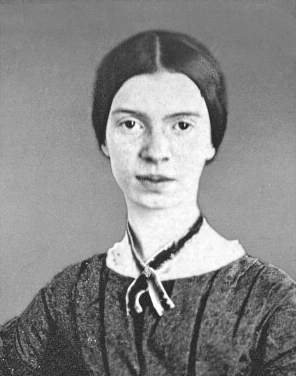
EMILY DICKINSON
EMILY DICKINSON (Amherst, Massachusetts, 1830 – 1886) lasciò alla morte quasi milleottocento poesie, e pochissime erano state pubblicate in vita. Il primo volume postumo, «Poems» (1890), fu curato da Mabel Loomis Todd e Thomas Wentworth Higginson. Le cinque poesie di questa scelta, brevi e celebri, vengono dalle edizioni postume di fine Ottocento: qui trovi il testo originale inglese e, sotto ciascuna, una resa italiana in prosa (non una traduzione poetica).
I’m nobody! (Non sono nessuno)
I’m nobody! Who are you?
Are you nobody, too?
Then there’s a pair of us — don’t tell!
They’d banish us, you know.
How dreary to be somebody!
How public, like a frog
To tell your name the livelong day
To an admiring bog!
Resa italiana: Non sono nessuno! Tu chi sei? Anche tu sei nessuno? Allora siamo in due: non dirlo! Ci metterebbero al bando, sai. Che noia essere qualcuno! Che cosa pubblica, come una rana, dire il proprio nome tutto il giorno a una palude che ti ammira!
Hope (La speranza)
Hope is the thing with feathers
That perches in the soul,
And sings the tune without the words,
And never stops at all,
And sweetest in the gale is heard;
And sore must be the storm
That could abash the little bird
That kept so many warm.
I’ve heard it in the chillest land,
And on the strangest sea;
Yet, never, in extremity,
It asked a crumb of me.
Resa italiana: La speranza è la cosa con le piume che si posa nell’anima, e canta la melodia senza le parole, e non smette mai; è più dolce che mai la si sente nel vento forte, e dev’essere aspra la tempesta che possa sgomentare il piccolo uccello che ha tenuto al caldo tanti. Io l’ho sentita nella terra più gelida e sul mare più straniero; eppure, mai, nemmeno nell’estremo bisogno, mi ha chiesto una briciola.
I never saw a moor (Non ho mai visto una brughiera)
I never saw a moor,
I never saw the sea;
Yet know I how the heather looks,
And what a wave must be.
I never spoke with God,
Nor visited in heaven;
Yet certain am I of the spot
As if the chart were given.
Resa italiana: Non ho mai visto una brughiera, non ho mai visto il mare; eppure so come appare l’erica e che cosa dev’essere un’onda. Non ho mai parlato con Dio, né visitato il cielo; eppure sono certa del luogo come se mi avessero dato la mappa.
Exclusion (L’anima sceglie)
The soul selects her own society,
Then shuts the door;
On her divine majority
Obtrude no more.
Unmoved, she notes the chariot’s pausing
At her low gate;
Unmoved, an emperor is kneeling
Upon her mat.
I’ve known her from an ample nation
Choose one;
Then close the valves of her attention
Like stone.
Resa italiana: L’anima sceglie la sua compagnia, poi chiude la porta; alla sua divina maggioranza non permette più di intromettersi. Imperturbata, nota il cocchio che si ferma al suo umile cancello; imperturbata, vede un imperatore inginocchiarsi sul suo stuoino. L’ho conosciuta, da una vasta nazione, sceglierne uno solo; poi chiudere le valvole della sua attenzione come pietra.
A Book (Un libro)
There is no frigate like a book
To take us lands away,
Nor any coursers like a page
Of prancing poetry.
This traverse may the poorest take
Without oppress of toll;
How frugal is the chariot
That bears a human soul!
Resa italiana: Non c’è fregata come un libro per portarci in terre lontane, né destrieri come una pagina di poesia che scalpita. Questa traversata può farla anche il più povero, senza il peso di un pedaggio; com’è frugale il cocchio che porta un’anima umana!
Sono cinque modi di dire la stessa cosa: che l’interiorità è un paese intero, e che per attraversarlo bastano un libro, un uccello, un’altra persona «nessuno».
EMILY DICKINSON, «Tutte le poesie» (testo inglese a fronte) su Amazon
Testo originale tratto da EMILY DICKINSON, «Poems» (1890-1896), edizione digitale Project Gutenberg. Rese italiane in prosa di Alloradillo.